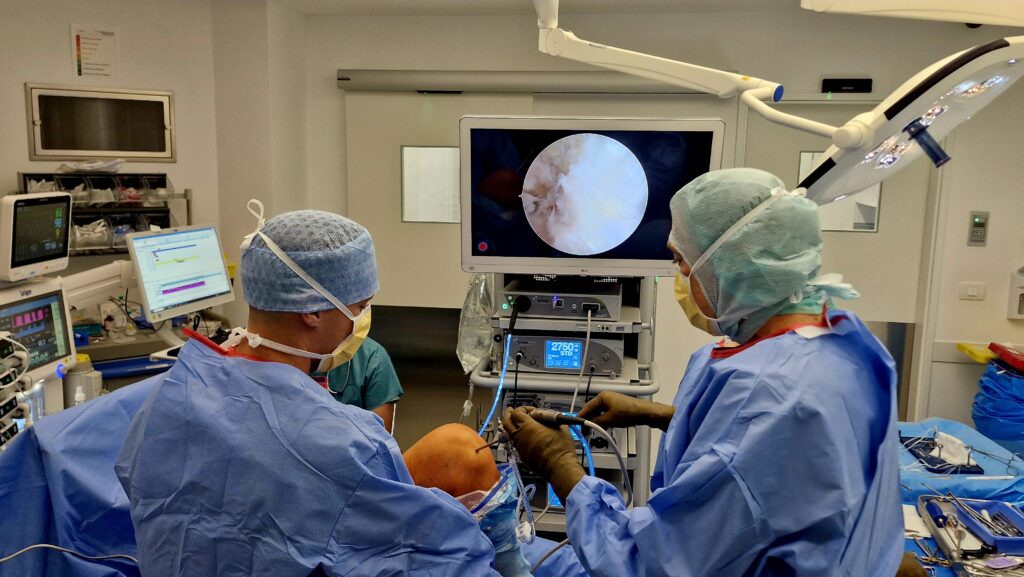
Knee arthroscopy is a minimally invasive surgical procedure that allows the inside of the knee joint to be examined in detail and various injuries to be treated. The procedure is often performed on an outpatient basis, with the surgeon accessing the joint through small skin incisions using a camera. This approach enables accurate diagnosis and targeted treatment of injuries through relatively small surgical incisions, helping to preserve knee joint function.
During the procedure, the surgeon inserts a special instrument called a trocar through small incisions, allowing the camera to be introduced into the joint. The camera displays the inside of the joint on a large screen, enabling the surgeon to examine the joint structures carefully and identify any injuries. Surgical instruments are inserted into the joint through additional access points known as portals. These instruments allow the surgeon to examine and probe the individual structures of the knee and perform the necessary therapeutic procedures.
One of the most common reasons for knee arthroscopy is meniscal injury. The menisci are two fibrocartilaginous structures within the knee joint that act as shock absorbers, helping distribute loads and contributing significantly to knee stability and proper function. The treatment approach depends on the type, extent and location of the injury. In some cases, the surgeon partially removes the damaged portion of the meniscus. Whenever possible, however, the aim is to preserve the meniscus and repair it using specialised sutures. Various surgical techniques and specialised instruments are available for arthroscopic meniscal repair.
Arthroscopy can also be used to treat articular cartilage injuries. Articular cartilage plays an important role in allowing the joint surfaces to glide smoothly and in distributing loads. Depending on the nature of the injury, the surgeon may smooth the damaged cartilage surface or remove unstable cartilage fragments. More advanced treatment options are available for complex injuries, including techniques involving specialised gels, membranes or grafts of the patient’s own cartilage tissue. The choice of the most appropriate treatment depends on the extent of the injury, the condition of the joint surfaces and other individual patient factors.
The duration of knee arthroscopy depends on the complexity of the procedure and the type of injury. Simpler procedures take approximately 10 minutes, while more complex ones may take up to 60 minutes or longer. Knee arthroscopy is usually performed under spinal or general anaesthesia, although local anaesthesia is used in some cases.