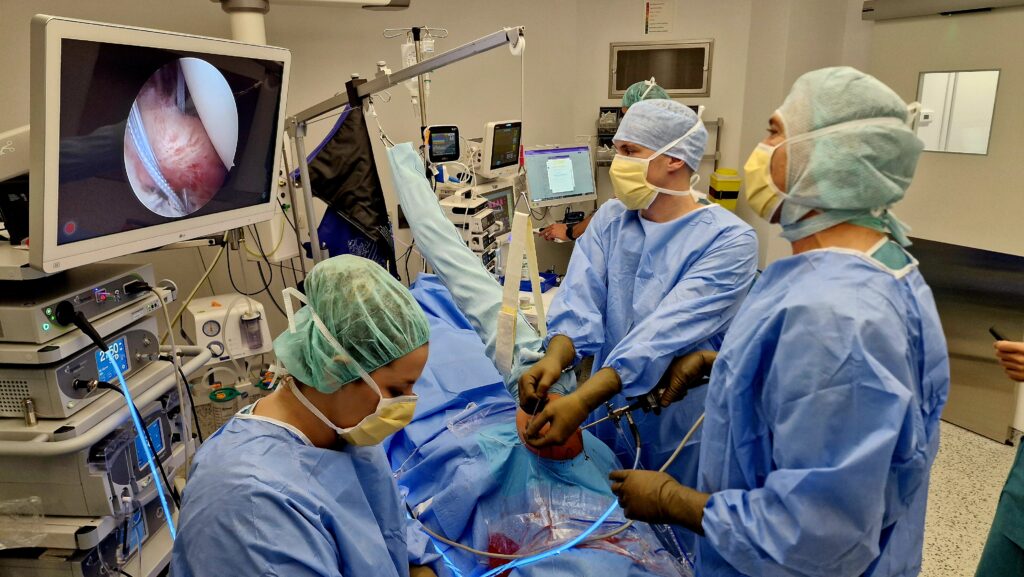
Shoulder arthroscopy is a minimally invasive surgical procedure in which the surgeon examines the shoulder joint through small skin incisions and treats damaged structures, such as the rotator cuff tendons, the biceps tendon or the labrum.
In rotator cuff injuries, which are more common in older patients, the tendons of the subscapularis, supraspinatus and infraspinatus muscles may be affected. The surgeon reattaches the damaged tendon to its insertion on the humerus using specialised sutures and suture anchors. In selected patients, the surgeon may also treat an injured biceps tendon during the same procedure.
In cases of shoulder instability, the surgeon repairs the damaged labrum. This is a strong fibrocartilaginous rim around the edge of the glenoid cavity that increases its surface area and contributes to joint stability. Following an injury, which may occur during a dislocation, the surgeon reattaches the labrum to the edge of the glenoid cavity using anchors and sutures.
The procedure typically takes one to two hours, although the duration depends on the type and extent of the injury and whether additional procedures are required. It is performed under general anaesthesia, often combined with a local anaesthetic technique to relieve pain. Patients can generally leave the hospital on the same day, with their arm supported in a sling.
After surgery, the shoulder must be protected to allow the repaired structures to heal. The sling is commonly worn for four to six weeks, although the duration depends on the type and extent of the surgical procedure and the surgeon’s instructions. Recovery then continues with a gradual physiotherapy programme. Following rotator cuff repair, full recovery may take six months or longer. It is essential to increase movement and physical loading gradually.
Interestingly, shoulder stability does not depend solely on the shape of the bones. The labrum, joint capsule and rotator cuff muscles also play important roles. Therefore, rehabilitation must focus not only on allowing the repaired structures to heal but also on gradually restoring joint mobility and muscle function.