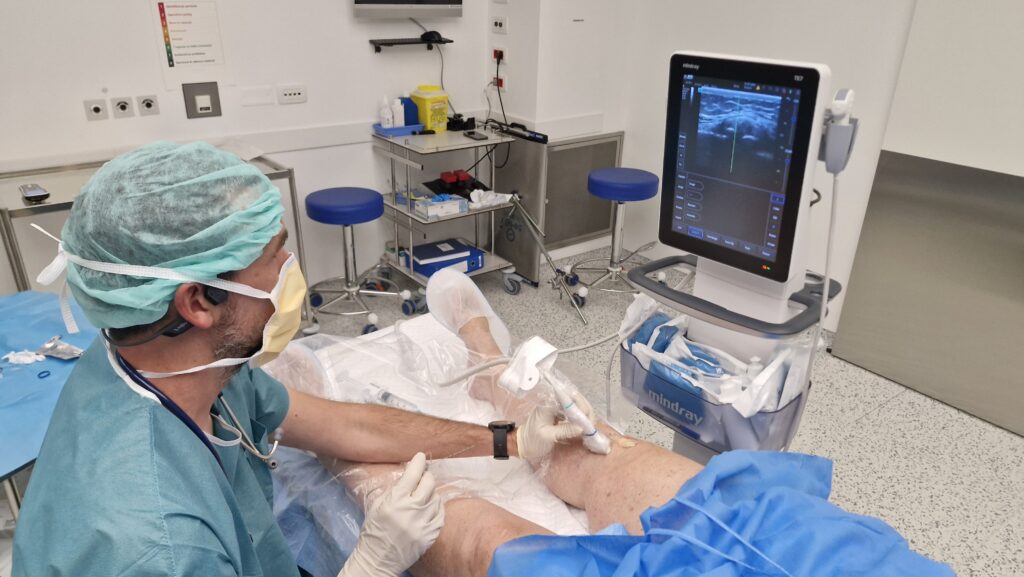
For procedures involving the lower part of the body, patients may choose spinal anesthesia instead of general anesthesia. In this case, the anesthetic is injected into the lower back, between the bones of the spine, numbing the lower part of the body so that the patient does not feel pain during the procedure, while remaining awake if desired. The effect usually lasts for one to two hours and is often combined with medication that provides pain relief for a longer period after the procedure. During the procedure, the patient may be fully awake, sedated or asleep, depending on what is agreed with the anesthesiologist. Spinal anesthesia, either alone or combined with sedation, is frequently used for orthopedic surgery involving the joints or bones of the legs, as well as for inguinal hernia surgery, varicose vein and hemorrhoid procedures, and vascular surgery of the legs.
How is the procedure performed?
First, a thin tube (cannula) is inserted into a vein in the arm to administer fluids and medications. The patient is then positioned appropriately – either sitting on the edge of the bed or lying on their side with their knees drawn towards their chest.
The skin is first numbed with a local anesthetic, which may cause a brief stinging sensation. The area then becomes numb to pain. The spinal injection is then administered, during which the patient must remain still; a nurse assists the patient in maintaining the correct position. The injection is generally no more painful than a routine blood test.
Shortly after the injection, the patient feels warmth in the legs, followed by tingling and a gradually increasing sensation of heaviness and numbness, often described as having “wooden legs”. Before the surgery can begin, the anesthesiologist checks whether the anesthesia is working using simple tests, such as applying a cold stimulus, touching the skin and asking the patient to lift their legs.
During the procedure
A screen positioned across the patient’s chest prevents them from seeing the surgical procedure. The patient may receive oxygen through a mask, listen to music and talk to the anesthesiologist, who remains with them throughout the procedure.
If a sedative is administered, the patient becomes even more relaxed and drowsy. Some patients remember the procedure completely, others only partially, while some have no memory of it at all.
If spinal anesthesia is insufficient or the procedure proves more complex, it is possible to switch to general anesthesia.
On the day of surgery
The patient must not eat for six hours before the procedure. Clear liquids may be consumed up to two hours before the procedure. Milk, carbonated drinks, alcohol, fruit juices and smoothies are not permitted during this period, as food or liquid in the stomach during anesthesia can be life-threatening.
Patients with diabetes, patients taking blood-thinning medication and smokers receive additional instructions.
Before coming to the operating room, the patient must remove nail polish, as a pulse oximeter is placed on the finger during anesthesia to measure blood oxygen saturation and heart rate through the nail. In particular, dark, glossy or thick nail polish, as well as gel or artificial nails, can make the measurement more difficult or affect its accuracy.
The patient must also remove all jewelry and piercings before the procedure.
After the procedure
Sensation in the legs returns completely within a maximum of four hours. During this time, the patient may experience tingling and mild pain, for which pain medication can be administered.
When first getting out of bed, the patient may feel unsteady on their feet and can ask the medical staff for assistance.
After spinal anesthesia, patients can generally resume eating and drinking sooner than after general anesthesia.
Benefits and risks
Compared with general anesthesia, the benefits include:
- lower risk of pulmonary infection;
- less impact on breathing;
- effective pain relief immediately after the procedure;
- less nausea and vomiting;
- faster return to eating and drinking.
Common but usually mild side effects include low blood pressure, itching and temporary difficulty urinating.
Pain during an injection at an unusual site or post-dural puncture headache, which occurs in approximately 1 in 200 to 500 procedures, are less common and can be appropriately treated by the anesthesiologist.
Permanent nerve damage is very rare, occurring in approximately 1 in 50,000 cases. This risk is comparable to the risk of more serious complications associated with general anesthesia.
Frequently asked questions
Can I eat and drink before the procedure?
The same rules apply as for general anesthesia: eating is prohibited for six hours before the procedure, while clear liquids may be consumed up to two hours before. Milk, carbonated drinks, alcohol, fruit juices and smoothies are not permitted.
Do I have to be awake?
No – together with the anesthesiologist, you can decide whether you wish to remain awake or prefer to be sedated.
Can I refuse anesthesia?
Yes, at any time, including during the preparation for anesthesia.
Is spinal anesthesia the same as epidural anesthesia?
No – with epidural anesthesia, a catheter remains in the back throughout the procedure, allowing additional doses of anesthetic to be administered.
Patients should discuss all risks and available options in detail with their anesthesiologist, who will help them choose the most appropriate type of anesthesia.