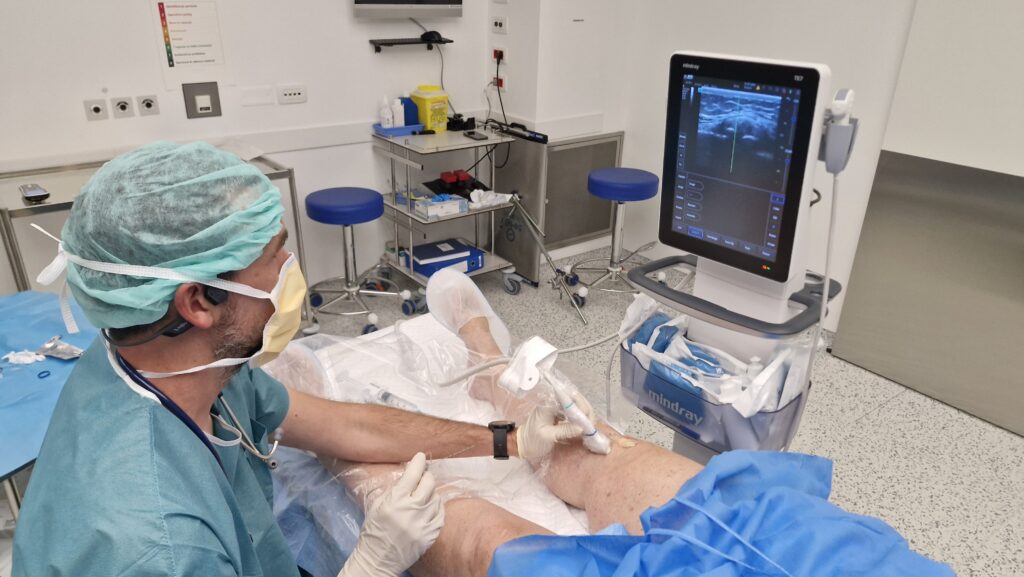
In addition to the conventional block of the entire brachial plexus, some shoulder procedures can be performed using a selective and less invasive option that involves blocking only two peripheral nerves (the suprascapular and axillary nerves).
About the Nerve Block
Instead of blocking the entire brachial plexus with an injection of local anesthetic in the neck or armpit (all the nerves that supply the arm from the shoulder to the fingers), this approach targets only the two nerves that contribute most to the sensation of pain in the shoulder joint itself.
The suprascapular nerve runs from the brachial plexus along the upper border of the scapula, close to the trapezius muscle, and supplies most of the shoulder joint capsule as well as the supraspinatus and infraspinatus muscles. The axillary nerve runs around the neck of the humerus along its posterior aspect and supplies the anterior part of the joint capsule and the deltoid muscle.
Together, these nerves transmit approximately 70–90% of the sensory signals from the shoulder joint. Blocking them therefore significantly reduces postoperative pain, while the other nerves of the brachial plexus (musculocutaneous, median, ulnar and radial nerves), which supply the muscles responsible for movement of the elbow, wrist and fingers, remain unaffected.
Less Invasive
Compared with a block of the entire brachial plexus (such as an interscalene block), this is a more peripheral and targeted technique that preserves motor function of the arm. After the procedure, the arm, wrist and fingers remain mobile because the musculocutaneous, radial, median and ulnar nerves are not blocked. This allows earlier mobilization and greater independence after surgery.
The risk of complications associated with brachial plexus blocks is also lower, with a significantly reduced likelihood of temporary phrenic nerve paralysis and the resulting breathing difficulties, which are relatively common with interscalene blocks. The risk of Horner’s syndrome is also lower.
Another advantage is the use of a smaller volume of anesthetic at more superficial and easily accessible sites (around the scapula and humerus), rather than deeper near the neck or clavicle.
What the Block Is and Is Not
This block provides additional analgesia after surgery rather than serving as the sole anesthetic for the procedure. It does not numb the skin at the incision site or the rest of the arm, so general anesthesia is still required for the surgery.
The advantage therefore lies in combining the two techniques: during surgery, the patient is under general anesthesia, while after surgery, the block of the two key nerves relieves shoulder pain for approximately 24 hours (and in some areas for up to 48 hours), while preserving arm mobility and strength to a greater extent than a conventional block of the entire brachial plexus.
Benefits
The main benefits include effective postoperative analgesia of the shoulder joint, preservation of motor function in the arm, wrist and fingers, and a lower risk of temporary phrenic nerve paralysis and associated breathing difficulties.
The procedure is also suitable for patients for whom a conventional brachial plexus block is less appropriate, for example because of impaired lung function.
How Is It Performed?
Both nerves are identified using an ultrasound device and a small amount of local anesthetic is injected: the suprascapular nerve is blocked near the upper border of the scapula, while the axillary nerve is blocked in the posterior shoulder region.
The procedure is performed while the patient is already under general anesthesia or immediately before induction of general anesthesia. Therefore, it does not require the patient to remain still or actively cooperate during the procedure.
Risks
The risks are similar to those associated with other peripheral nerve blocks: temporary numbness or tingling at the injection site, a small risk of bleeding that can be controlled by applying pressure, and a very rare risk of nerve injury.
Because the injection is performed at a more peripheral and superficial site than with a brachial plexus block, the risk of pneumothorax or phrenic nerve paralysis is significantly lower.
Depending on the type of surgery and the patient’s health condition, the anesthesiologist will determine whether this less invasive approach is appropriate or whether a conventional block of the entire brachial plexus would be more suitable.